Obelisks in Rome: Why the City Has 13 and Where to See Them
Rome has 13 ancient obelisks, the most in the world: eight carved in Egypt and five made for Romans. See where each stands and how it got there.
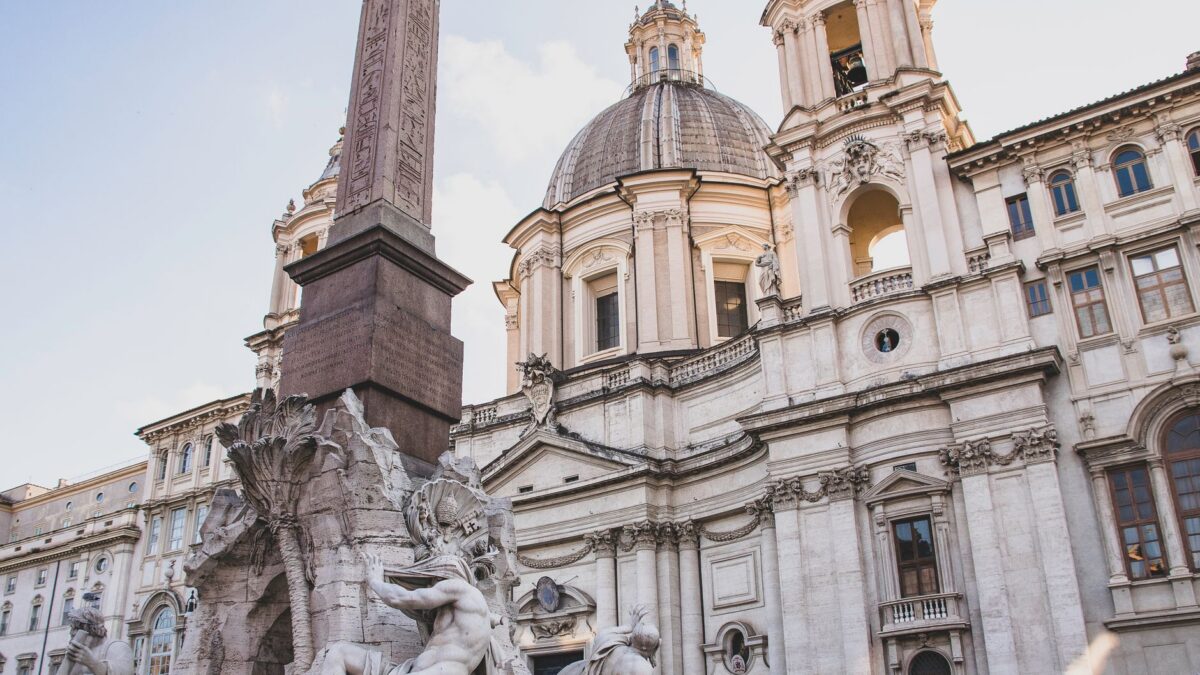
Rome has thirteen ancient obelisks, more than any other city in the world. Eight were carved in ancient Egypt and shipped to Rome on the orders of emperors, and five were made in the Roman period, either quarried in Egypt for wealthy Romans or produced as copies of Egyptian originals. Most of them fell or were buried after antiquity, and popes raised them again in the city’s squares from 1586 onward.
How did Egyptian obelisks get to Rome?
Emperors took some obelisks from Egyptian temples as spoils of conquest, while rich Romans commissioned others from Egyptian quarries for public or private use. According to the Wikipedia list of obelisks in Rome, the stones travelled down the Nile to Alexandria on heavy cargo vessels known as obelisk ships, then crossed the Mediterranean. Large Roman cranes lifted them upright once they arrived.
Nobody kept an inventory before the fall of Rome, so the number that once stood in the ancient city is unknown. A traditional estimate puts it as high as 48, but no single ancient source gives that figure and it is probably a modern guess. Rome also has more than 30 modern obelisks, among them one dedicated to Marconi and one dedicated to Mussolini.
Which obelisks came from ancient Egypt?
Eight of Rome’s obelisks were made by the Egyptians themselves. Several come from Heliopolis, a sacred city near modern Cairo.
- Lateranense, Piazza di San Giovanni in Laterano: from the Temple of Amun at Karnak, brought to Rome in 357 AD by Constantius II. It was rediscovered in 1587 and raised again by Pope Sixtus V in 1588. At 45.70 m in total (32.18 m for the shaft) it is the tallest in Rome and the largest standing ancient Egyptian obelisk anywhere.
- Vaticano, St. Peter’s Square: Augustus first set it up in Alexandria, and Caligula moved it to Rome in 40 AD for the Vatican Circus. Sixtus V re-erected it in 1586. It is the only obelisk in Rome that has not fallen since Roman times.
- Flaminio, Piazza del Popolo: from Heliopolis, brought by Augustus in 10 BC, found again in 1587 and put back up by Sixtus V in 1589.
- Solare, Piazza di Montecitorio: also from Heliopolis and also brought by Augustus in 10 BC, when it served as the pointer (gnomon) of a giant sundial, the Solarium Augusti. Pope Pius VI raised it in 1792.
- Macuteo, Piazza della Rotonda: from Heliopolis, set in front of the Pantheon by Pope Clement XI in 1711.
- Minerveo, Piazza della Minerva: from Sais in the Nile Delta, brought to Rome by Diocletian. Pope Alexander VII placed it on Bernini’s elephant base in 1667.
- Dogali, near the Baths of Diocletian: from Heliopolis, rediscovered in 1883 and put up as a memorial to the Battle of Dogali, an Italian defeat in East Africa.
- Matteiano, Villa Celimontana: from Heliopolis, reassembled from fragments in 1820.
Which obelisks were made for Romans?
Five obelisks date from the Roman period. Some were cut in Egypt to Roman order, others were made in Rome in imitation of Egyptian work.
- Agonalis, Piazza Navona: commissioned by Domitian and first raised at the Temple of Serapis. Maxentius later moved it to his own circus, and in 1651 Bernini set it on top of the Fontana dei Quattro Fiumi (the Fountain of the Four Rivers).
- Quirinale, Piazza del Quirinale, and Esquiline, Piazza dell’Esquilino: a pair that once flanked the Mausoleum of Augustus. Both were found in 1527. Sixtus V put the Esquiline one behind Santa Maria Maggiore in 1587, and Pius VI raised the Quirinale one in 1786.
- Sallustiano, Trinità dei Monti: a copy of the Flaminio obelisk made under Aurelian for the Gardens of Sallust. Pius VI placed it above the Spanish Steps in 1789.
- Pinciano, Pincian Hill: commissioned by Hadrian for the tomb of his companion Antinous at Tivoli, moved to Rome by Elagabalus and finally erected on the Pincio by Pope Pius VII in 1822.
Why did the popes raise them again?
The obelisks you see today stand where popes chose to put them, not where the emperors did. Sixtus V alone re-erected four between 1586 and 1589, placing them in front of major churches and at the end of long streets, where they still mark the way across the city. Later popes, including Alexander VII, Clement XI, Pius VI and Pius VII, added more. A walk from Piazza del Popolo past Trinità dei Monti to the Quirinale passes several of them, and the obelisks at the Pantheon and Piazza della Minerva are a few minutes apart.
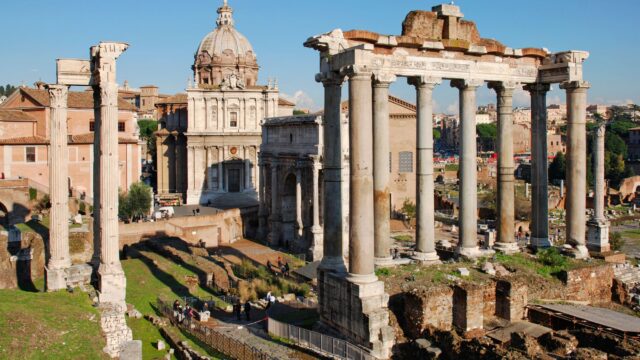
For the older layer of the city underneath these squares, see our history of how the Roman Forum grew out of a marsh.
Have any obelisks left Rome?
Yes. Some ancient obelisks that once stood in Rome were moved to other cities. A small one from Sais that stood at the Iseum Campense, a temple of Isis in the Campus Martius, went to Urbino in 1737 and now stands beside the Palazzo Ducale. Another from Heliopolis, also once at the Iseum, was taken to Florence in 1788 and set up in the Boboli Gardens in 1790.
The best-known departure is the Obelisk of Axum. As the Wikipedia article on the Obelisk of Axum explains, this is a 4th-century stele from the Kingdom of Aksum in what is now Ethiopia, 24 m tall and weighing 160 tonnes. Italian forces took it as war loot in 1937. It was cut into three sections, driven to the port of Massawa, shipped to Naples (arriving March 27, 1937) and reassembled in Rome at Porta Capena, in front of the Ministry for Italian Africa, the building that later became the headquarters of the UN Food and Agriculture Organization, near the Circus Maximus. It was unveiled on Oct. 28, 1937, the fifteenth anniversary of the March on Rome. A bronze Lion of Judah taken at the same time stood in front of Termini station.
Under a 1947 UN agreement Italy promised to return both. The lion went back in 1967, but the stele stayed in Rome for decades, partly because moving it was so difficult. Work to take it down began in November 2003. Axum’s runway had to be upgraded first, and the three pieces were flown home in an Antonov An-124 on April 19, April 22 and April 25, 2005. Italy paid $7.7 million for the operation.
Quick answers
How many obelisks are in Rome?
Thirteen ancient ones: eight Egyptian and five Roman. There are also more than 30 modern obelisks.
Which is the tallest obelisk in Rome?
The Lateranense obelisk in Piazza di San Giovanni in Laterano, at 45.70 m including its base. It is also the largest standing ancient Egyptian obelisk in the world.
Which obelisk has never fallen?
The Vatican obelisk in St. Peter’s Square, brought by Caligula in 40 AD, is the only one in Rome that has stayed standing since Roman times. Sixtus V moved it to its present spot in 1586.
Is the Axum obelisk still in Rome?
No. It was returned to Ethiopia in three flights in April 2005.
Checked against official sources in November 2026. Hours, prices and rules change: confirm on the official page before you go or apply.