Roman Forum History: How a Marsh Became the Centre of Rome
The Roman Forum began as a marshy lake that the Tarquins drained with the Cloaca Maxima. How it grew into Rome's centre, and what is left to see today.
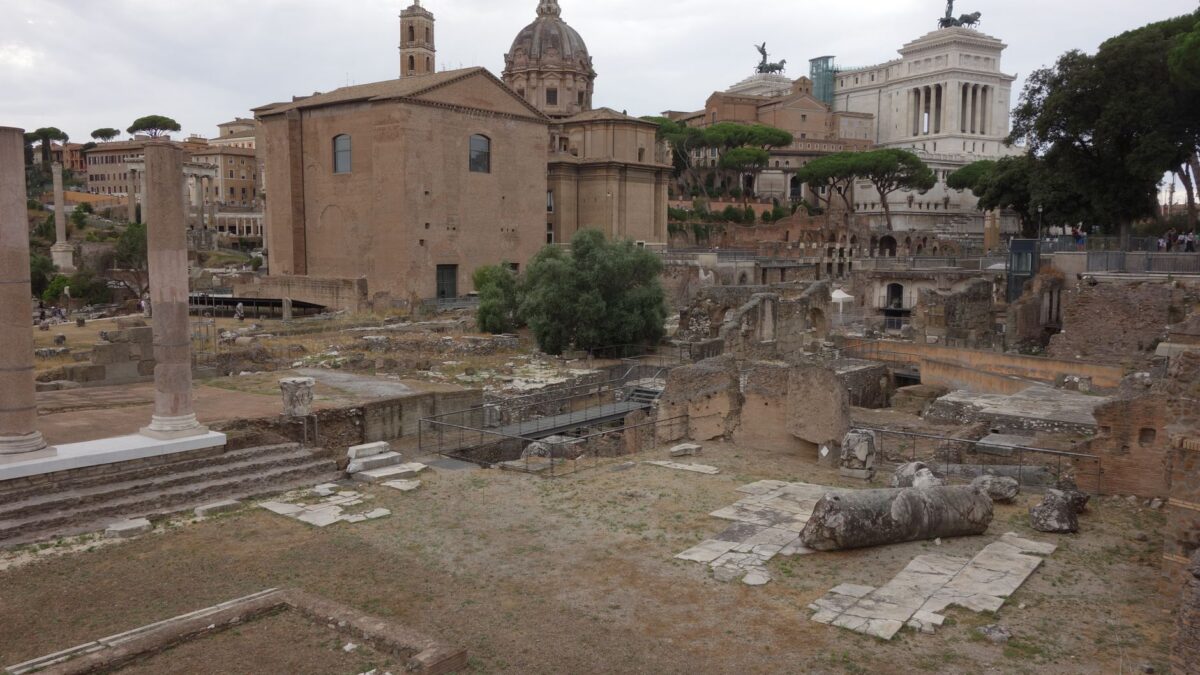
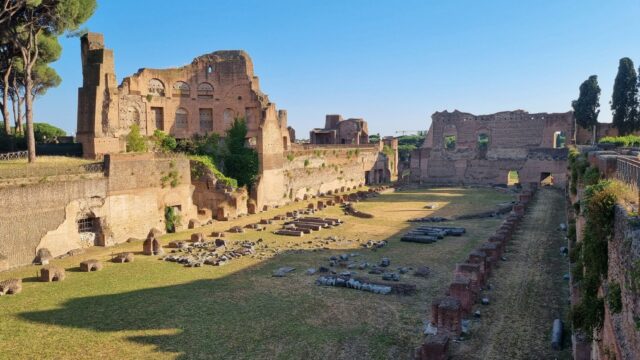
The Roman Forum, or Foro Romano, sits in a small valley between the Palatine and Capitoline hills that was once a marshy lake fed by water running off the slopes. After the Tarquins, Rome’s early kings, drained it through the Cloaca Maxima (the great sewer), the low ground became the city’s main square. Elections, trials, speeches, markets and triumphal processions all took place there, and the area was built up from the 8th century BC until AD 608.
Today the Forum covers about 2 ha of ruins and ongoing excavations, and its floor lies about 13 m above sea level. The page of the Roman Forum on Wikipedia puts visitor numbers at 4.5 million or more a year.
Why was the Forum a marsh?
The valley was the lowest point between several hills, so rainwater collected there and formed a wet, boggy basin. Draining it with the Cloaca Maxima made the land usable for building. The site kept a problem, though: floods from the Tiber and soil washing down from the hills kept raising the ground level for centuries.
Excavated layers of old paving show the ground was already rising in the early years of the Republic. Romans could not cart away so much debris, so they laid new paving on top of it. The travertine paving you can still walk past today dates from the reign of Augustus. When archaeologists dug down in the 19th century, they found one level stacked on another, and the deepest layer they reached, 3.60 meters above sea level, held carbonized wood left by human activity.
Who lived there before Rome?
People were on these hills long before the city had a forum. Pottery found in the Forum and on the Palatine and Capitoline points to settlement in the Final Bronze Age (1200 to 975 BC). In the early Iron Age, part of the future square, near where the Temple of Antoninus and Faustina now stands, was a cemetery in use in the 10th century BC, possibly by the villages on the two hills.
Most of those burials were cremations of a type found across Latium (the region around Rome). The ashes went into an urn, which was set inside a large clay jar with grave goods, placed in a pit and capped with a stone. A few bodies were buried without cremation.
How did it become the centre of Roman government?
The oldest shrines and temples stood on the southeastern edge. These included the Regia, the former royal residence (8th century BC), the Temple of Vesta (7th century BC) and the house of the Vestal Virgins next to it. All of them were rebuilt later, under the emperors.
To the northwest, early shrines such as the Umbilicus Urbis and the Vulcanal, a shrine to Vulcan, grew into the Comitium, the Republic’s assembly ground. The Senate first met in this area. Over the years a Senate house, offices, courts, temples and statues filled the space around it.
The Comitium was eventually overtaken by the larger Forum next to it. Court business moved to the Basilica Aemilia, built in 179 BC. Some 130 years later Julius Caesar added the Basilica Julia and a new Senate house, the Curia Julia, which shifted both the courts and the Senate again. From then on the square kept its final layout: a public space for trade, politics, law and religion.
What happened to the Forum later?
Much of the city’s trade and legal work later moved north to Trajan’s Forum and the Basilica Ulpia, which were larger and grander. The last big addition to the Forum came under Constantine the Great: the Basilica of Maxentius, from 312 AD. Political life returned to the square until the Western Roman Empire fell almost two centuries later. From the 8th century AD onward, the site was largely neglected.
Trajan’s complex is still being opened up to visitors, and Rome recently made an underground library at Trajan’s Forum accessible to the public.
What did the square look like at its peak?
Later imperial forums in Rome copied the planned Greek town square. The Roman Forum never had a single plan and grew piece by piece, even though Sulla, Julius Caesar, Augustus and others tried to bring some order to it. By the imperial period, large public buildings crowded around an open rectangle of about 130 by 50 meters.
The long side ran northwest to southeast, from the foot of the Capitoline Hill to the Velian Hill. The Basilica Aemilia closed the north side and the Basilica Julia the south. An extra strip, the Forum Adjectum, sometimes counted as part of the Forum and reached southeast as far as the Arch of Titus.
What route did a Roman triumph take?
A triumph was the parade granted to a victorious general, and the Forum was where it ended. The general entered Rome through the Porta Triumphalis (Triumphal Gate) on the west side and went counterclockwise around the Palatine Hill. He then came down from the Velian Hill along the Via Sacra into the Forum. From there the procession climbed the Clivus Capitolinus (the Capitoline Rise) to the Temple of Jupiter Optimus Maximus on top of the Capitol, and big public banquets followed back in the Forum.
Several other old streets led into the square too, among them the Vicus Jugarius, the Vicus Tuscus, the Argiletum and the Via Nova.
How to see it today
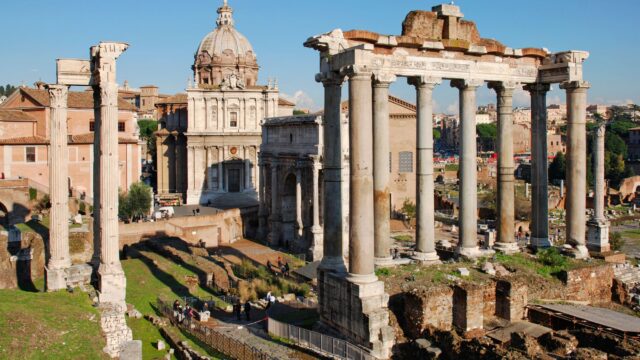
Most of the buildings are ruins, but you can still trace the layout described above: the Via Sacra, the two basilicas along the long sides, the Curia, the Temple of Vesta area to the southeast and the Arch of Titus at the far end. The site is open to the public and run through parcocolosseo.it, the official website of the archaeological park. For entrances, a walking route and opening times, see our guide to visiting the Roman Forum and Palatine Hill. If you are arriving by plane, there are options for getting from Fiumicino Airport into central Rome.
Quick answers
What was the Roman Forum used for?
It was the city’s main public square. Romans held elections, trials, public speeches and triumphal processions there, and it was also a centre of trade and law.
Who drained the marsh under the Forum?
The Tarquins, the early kings of Rome, drained the marshy lake with the Cloaca Maxima.
Why is the ancient ground level so deep?
Tiber floods and soil eroding off the hills raised the ground for centuries, and Romans paved over the debris instead of removing it. The deepest level excavated is 3.60 meters above sea level.
What was the last major building in the Forum?
The Basilica of Maxentius, built in 312 AD during the reign of Constantine the Great.
Checked against official sources in November 2026. Hours, prices and rules change: confirm on the official page before you go or apply.