From Republic to Empire: How Rome Went From Caesar to Augustus
Rome stopped being a republic between Caesar's crossing of the Rubicon in 49 BC and the title Augustus in 27 BC. Dates, people and places in the city.
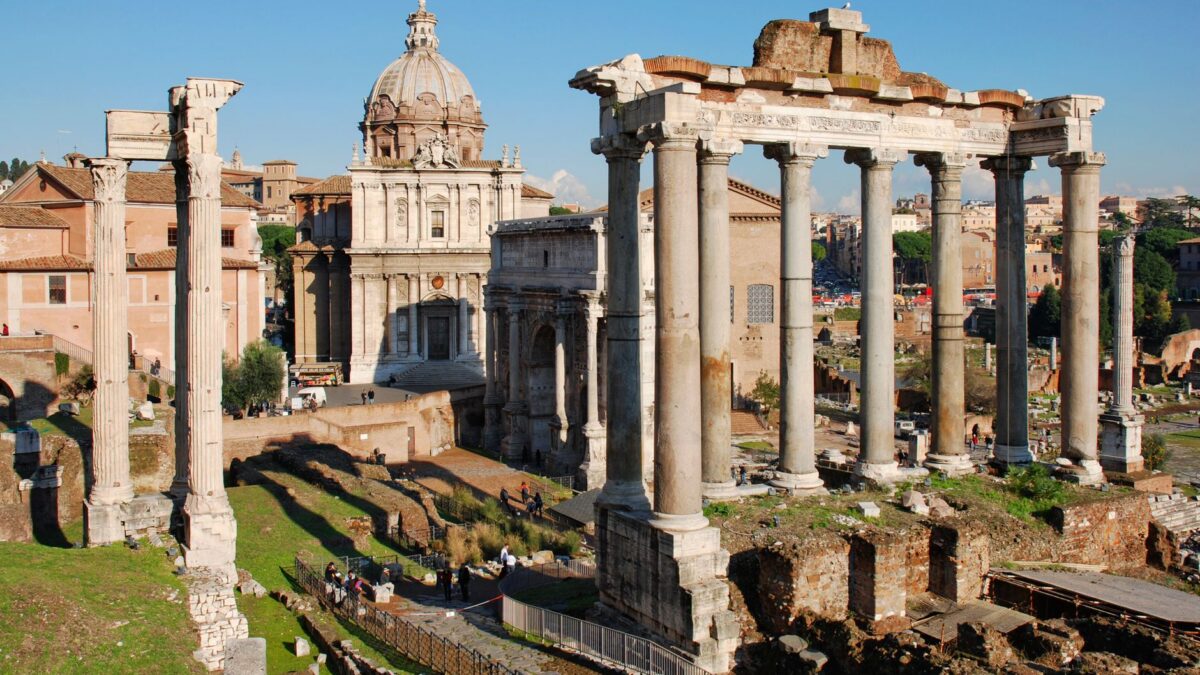
The Roman Republic ended in stages over about two decades. Julius Caesar crossed the Rubicon with an army in early January 49 BC, won the civil war that followed and was killed on the Ides of March in 44 BC. His heir Octavian then defeated every rival, and on Jan. 16, 27 BC the Senate gave him the title Augustus, the date usually taken as the start of the Roman Empire.
What was the Roman Republic?
The Republic began, by tradition, in 509 BC, when the last king, Tarquin the Proud, was expelled and his powers passed to two consuls elected for one year, each able to veto the other. The Wikipedia history of the Roman Republic describes a system of annual magistrates overseen by a senate, with yearly elections. In practice it was an elective oligarchy in which a few powerful families held most senior offices. For the much older story of how the city began, see our piece on Romulus, Remus and what archaeology shows.
The state grew fast. Rome controlled about 10,000 km2 in 326 BC and about 1,950,000 km2 in 50 BC. After defeating Carthage at Zama in 202 BC, it became the dominant power around the Mediterranean.
Why did the Republic start to break down?
Trouble at home grew from 133 BC onward. Politicians later grouped as optimates (conservatives) and populares (reformers) fought over land, power and citizenship. The Social War between Rome and its Italian allies spread violence across the peninsula, and mass slavery led to three Servile Wars.
Generals with their own loyal armies made things worse. The first civil war set Marius against Sulla, whose side won in 82 BC. A generation later the same pattern returned on a larger scale.
Who was Julius Caesar before the Rubicon?
Gaius Julius Caesar was born on July 12 or 13, 100 BC, in the Suburra district of Rome, into the patrician gens Julia. In 60 BC he formed the First Triumvirate with Crassus and Pompey, an informal pact that dominated politics for several years. Cato the Younger led much of the opposition in the Senate, with Cicero supporting him privately.
The Wikipedia biography of Julius Caesar notes that his Gallic Wars, finished by 51 BC, added large territories to Rome. During those campaigns he invaded Britain and bridged the Rhine. His fame and his veteran army began to overshadow Pompey, who had moved over to the Senate’s side by 50 BC.
What happened when Caesar crossed the Rubicon?
The Senate ordered Caesar to give up his command and come back to Rome as his term in Gaul ran out. In early January 49 BC he refused. He crossed the Rubicon and marched on Rome with his army, which started a civil war against Pompey. Caesar won it, and by 45 BC nobody could seriously challenge him.
He held the office of dictator almost without a break from 49 BC to 44 BC. In that time he pardoned many former enemies and pushed through reforms:
- the Julian calendar, which replaced the old lunisolar calendar
- a smaller grain dole for the city
- new colonies overseas for his veterans
- a much larger Senate
- citizenship for communities in Spain and in what is now northern Italy
Why was Caesar assassinated?
Early in 44 BC he was named dictator perpetuo, dictator for life. Senators feared he would make himself king. A group led by Brutus and Cassius stabbed him to death on March 15, 44 BC, at the Theatre of Pompey in Rome. He was 55.
The killing did not bring the old system back. New civil wars began, and the constitutional government of the Republic was never fully restored.
How did Octavian take power?
Octavian, born Gaius Octavius on Sept. 23, 63 BC, at a family property on the Palatine Hill, was Caesar’s great-nephew: his mother, Atia, was Caesar’s niece. Caesar’s will named him principal heir, so in 44 BC he took both the estate and the name. Historians call him Octavian for the years between 44 and 27 BC.
His rise, as set out in the Wikipedia biography of Augustus, went like this:
- He won over Caesar’s legions, then marched on Rome in 43 BC and became its youngest elected consul.
- With Mark Antony and Marcus Lepidus he formed a triumvirate, given legal powers to pursue Caesar’s killers.
- The three beat the assassins at Philippi in 42 BC and divided the Roman world among themselves.
- He had Lepidus exiled in 36 BC after a clash in Sicily.
- His admiral Marcus Agrippa defeated Antony and Cleopatra at Actium, in Greece, on Sept. 2, 31 BC.
- Antony and Cleopatra killed themselves during Octavian’s invasion of Egypt, which became his personal property.
When did the Republic officially become an Empire?
No law abolished the Republic. Octavian kept its outward forms: the Senate, the elected magistrates and the assemblies all went on meeting. Real power came from his command of most of the armies and his control of half the provinces.
On Jan. 16, 27 BC, the Senate granted him the name Augustus, meaning “the revered.” That date is usually treated as the end of the Republic. To avoid looking like a king or dictator, he later stopped standing for consul, but the Senate gave him the powers of the tribunate and the censorship, plus the titles princeps (“first citizen”) and pater patriae (“father of the country”). The month of August was named after him, and after Lepidus died he also became pontifex maximus, the chief priest. Historians call this arrangement the principate. It lasted until the Crisis of the Third Century.
What did Augustus change in the city of Rome?
Augustus renovated much of Rome. He set up the Praetorian Guard and official police and fire services, reformed taxes and coinage, and built roads with an official courier system. Under his rule the Roman world entered the Pax Romana, a long stretch largely free of war.
He died at Nola on Aug. 19, AD 14, aged 75. The Senate declared him a god, his stepson Tiberius succeeded him, and he was buried in the Mausoleum of Augustus in Rome. Later emperors kept building on the same scale; one example is the recently opened underground library at Trajan’s Forum.
Quick answers
Did Julius Caesar become emperor?
No. Caesar was dictator, made dictator for life in 44 BC, but he was killed that year. His heir Augustus is counted as the first Roman emperor, from 27 BC.
Where in Rome was Caesar killed?
At the Theatre of Pompey, on March 15, 44 BC.
Why is August named after Augustus?
The Senate renamed the month in his honor as one of the titles it gave him.
Where is Augustus buried?
In the Mausoleum of Augustus in Rome.
Checked against official sources in November 2026. Hours, prices and rules change: confirm on the official page before you go or apply.