Appian Way History: Rome’s First Great Road Explained
The Appian Way (Via Appia) linked Rome to Brindisi from 312 BC. See who built it, why, how it was paved and what the UNESCO listing covers.
The Appian Way (Via Appia) is the Roman road that connected Rome to Brindisi in southeast Italy. It was begun in 312 BC by the censor Appius Claudius Caecus as a military road to the south, and it became one of the most strategically important roads of the Roman Republic. In July 2024 it was added to the UNESCO World Heritage List. This guide draws on the Appian Way article on Wikipedia.
Why was the Appian Way built?
Rome built it to supply and move troops. Around 343 BC Rome tried to ally with Capua, in Campania, and the Samnites answered with force. During the First Samnite War (343 to 341 BC) the Romans found they could not support or resupply an army across the Pontine Marshes, a malarial swamp between Rome and Capua.
The Second Samnite War (327 to 304 BC) followed when Rome tried to plant colonies at Cales and Fregellae. A road that crossed the marshes was the missing piece. Once it existed, fresh troops could reach the front and supplies could travel in bulk, whatever the terrain or the enemy did. The source calls the road the main factor that let Rome concentrate and feed its forces, and the war ended in Rome’s favor.
Who was Appius Claudius Caecus?
Appius Claudius became censor in 312 BC. He belonged to the patrician gens Claudia and was a populist, meaning an advocate of ordinary people. The surname Caecus means “blind”: he was said to have lost his sight in later life, and the source notes that blindness in ancient literature was sometimes linked to great vision.
He did not wait for instructions from the Senate. Besides the road he started the Aqua Appia, an aqueduct that secured Rome’s water supply. He later served as consul twice, according to the source.
How long is the road and where does it run?
The route runs from the Roman Forum to Brindisi and measures 335.5 miles (540 km). The record of construction gives 312 to 244 BC, and the emperor Trajan later added a branch known as the Via Appia Traiana. The poet Statius gave the road its famous nickname, regina viarum, “the queen of the long roads.”
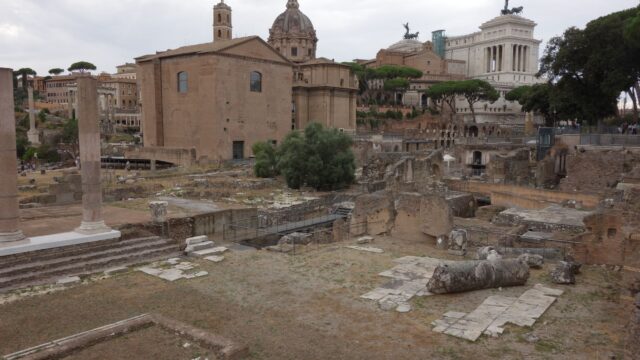
The road left Rome from the Forum and passed through the Servian Wall at the Porta Capena. For this first stretch the builders used the existing Via Latina. When the Aurelian Wall was built centuries later, a new gate, the Porta Appia, had to be added. Outside the city the road ran through well-off suburbs along the Via Norba, the ancient track to the Alban Hills.
How was it paved?
The road began as a leveled dirt path covered with small stones and mortar. A gravel layer went on top, then a final surface of tightly fitting interlocking stones, which made it flat and durable. The historian Procopius remarked that the stones fit so precisely that they seemed to have grown together rather than been set by hand.
The road was raised in the middle so water ran off, with ditches on both sides and low retaining walls where it ran through sunken ground. Dirt paths served as sidewalks. The Via Appia is believed to be the first Roman road to use lime cement, and its materials were volcanic rock.
What is there to see today?
Along the road outside Rome, visitors find ancient tombs and the underground burial galleries known as catacombs. Opening hours, ticket prices and bus connections change, so check the current details in our guide to visiting the Appian Way and its catacombs before you go.
The road is also a stretch of the city’s wider ancient infrastructure. If you are interested in how Rome’s underground history surfaces in modern building work, our article on why the Rome Metro took decades and what the digs found covers another side of it. For present-day traffic near the road, see the report on jams on the ring road after an Appia tunnel crash.
Quick answers
Where does the Appian Way start?
It started in the Roman Forum, left the city through the Porta Capena in the Servian Wall and ended at Brindisi.
Is the Appian Way a World Heritage site?
Yes. It entered the UNESCO World Heritage List in July 2024 under the official name Via Appia. Regina Viarum.
Why is it called the queen of roads?
The nickname comes from a line by the poet Statius, who called it the queen of the long roads (regina viarum).
Checked against official sources in November 2026. Hours, prices and rules change: confirm on the official page before you go or apply.