Who Built the Colosseum: Flavian Emperors, Games and Ruin
The Colosseum was begun by Vespasian in 72 and finished by Titus in AD 80. How it was used, where its name comes from and why only part of it stands.
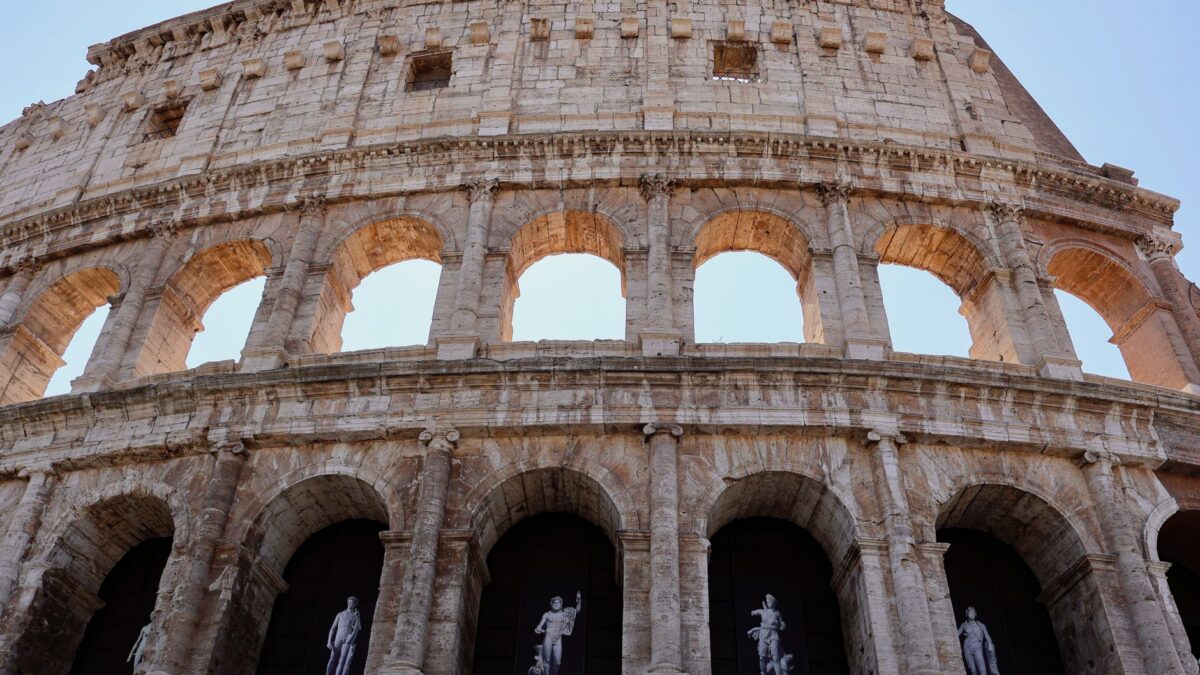
The Colosseum was built by the Flavian emperors: Vespasian started it in 72, his son Titus completed it in AD 80, and Domitian made further changes during his reign. It held crowds of tens of thousands for gladiator fights and other shows, stopped being used for entertainment in the early Middle Ages, and lost much of its structure to earthquakes and to people carting off its stone.
Today it is the largest ancient amphitheatre ever built and the largest one still standing anywhere, according to the Wikipedia entry on the Colosseum. It sits just east of the Roman Forum. If you plan to go inside, our page on Colosseum tickets, the combined pass and free days covers entry.
Who built the Colosseum?
Three emperors from one family paid for the work. Vespasian, who ruled from 69 to 79 AD, began construction; Titus, emperor from 79 to 81, finished it; and Domitian, who reigned from 81 to 96, modified it. Together they make up the Flavian dynasty, described on Wikipedia’s page on the Flavian dynasty as Vespasian and his two sons, with no extended or adopted relatives.
The family came to power through civil war. In the Year of the Four Emperors, 69 AD, legions in the eastern provinces proclaimed their commander Vespasian emperor. Flavian troops entered Rome on Dec. 20, and the Senate recognised Vespasian the following day. The dynasty ended on Sept. 18, 96, when Domitian was assassinated.
Titus’s short reign was hit by disasters, including the eruption of Mount Vesuvius in 79 AD that buried Pompeii and Herculaneum, and a fire and plague in Rome the year after. He also ran a large building programme to celebrate the new dynasty, and the amphitheatre was its most spectacular result.
Why was it built on that spot?
The site is a flat valley floor between the Caelian, Esquiline and Palatine hills, once crossed by a channelled stream and an artificial lake or marsh. The area was crowded with homes by the 2nd century BC. After the Great Fire of Rome in 64 AD, Nero took much of the land for himself, built his Domus Aurea palace there and created an artificial lake in front of it, ringed by gardens and porticoes. The Flavians later put their amphitheatre on this ground.
How did the Colosseum work?
The building is an ellipse made of travertine, tuff (a volcanic rock) and Roman concrete, which was used for the foundations, the vaults over the corridors and the secondary brick walls. Estimates of its capacity range from 50,000 to 80,000 spectators at different points in its history, with an average crowd of around 65,000.
The arena staged gladiatorial contests and many other public shows:
- animal hunts and executions
- re-enactments of famous battles
- plays based on Roman mythology
- for a short time, mock sea battles
Where does the name Colosseum come from?
In ancient times the building was simply called amphitheatrum, Latin for amphitheatre. The name Flavian Amphitheatre, or Amphitheatrum Flavium, came from later classicists and archaeologists, and there is no evidence that Romans used it.
The modern name is thought to come from the Colossus of Nero, a giant bronze statue modelled on the Colossus of Rhodes. Hadrian, who ruled from 117 to 138, moved the statue to a spot beside the amphitheatre. By the year 1000 the Latin word Colosseum was in use for the building. A famous 8th-century saying credited to the Venerable Bede, “as long as the Colossus stands, so shall Rome,” is often taken to mean the amphitheatre, but at the time the word referred to the statue.
Why does only part of it survive?
Once the games ended in the early medieval period, the building was put to new uses. People lived in it and set up workshops; it housed a religious order, served as a fortress and became a Christian shrine. It was also used as a quarry. Earthquakes and stone robbers, who took blocks for reuse elsewhere (known as spolia), left it badly damaged, which is why large sections are missing today.
The surviving structure is still a symbol of Imperial Rome. It was named one of the New 7 Wonders of the World, appears on the Italian 5 euro cent coin, and every Good Friday the pope leads a torchlit Way of the Cross procession that begins in the area around it.
Quick answers
How long did it take to build the Colosseum?
Work began under Vespasian in 72 and was completed under Titus in AD 80, with later changes under Domitian.
How many people did the Colosseum hold?
Estimates range from 50,000 to 80,000 spectators over its history, with an average audience of about 65,000.
Was it always called the Colosseum?
No. Romans called it the amphitheatre, and the name Colosseum, taken from the nearby Colossus of Nero, was in use by the year 1000.
Checked against official sources in November 2026. Hours, prices and rules change: confirm on the official page before you go or apply.