Rome Fountains Guide: Trevi, Four Rivers and Nasoni
Rome has over 2000 fountains, from the Trevi and Four Rivers to free nasoni drinking taps. Where each stands, its history and how nasoni work.
Rome has fifty monumental fountains and hundreds of smaller ones, more than 2000 in all, according to Wikipedia’s list of fountains in Rome. The big Baroque showpieces sit in Piazza Navona, Piazza Barberini and at the Trevi, while the small cast-iron nasoni give free drinking water on ordinary streets. This guide takes the main ones in turn and explains how the nasoni work.
Fontana di Trevi
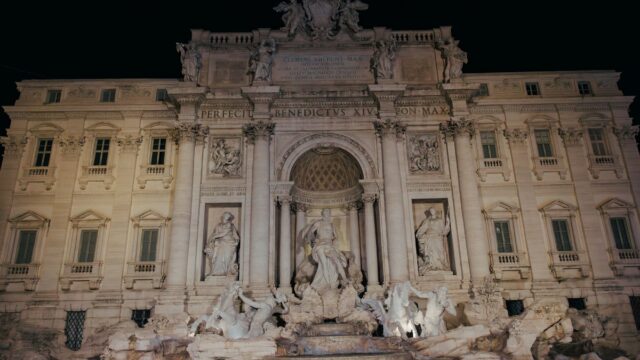
The Trevi Fountain is the largest and most spectacular of Rome’s fountains. Construction began in 1730 at the end of the rebuilt Acqua Vergine aqueduct, on the site of an earlier fountain by Leon Battista Alberti. Architect Nicola Salvi designed it, and three popes carried the project forward in turn: Clement XII, Benedict XIV and Clement XIII. Their emblems and inscriptions appear on the attic story, the entablature and the central niche.
The central figure is Oceanus, who stands for all the seas and oceans, riding an oyster-shell chariot among Tritons and sea nymphs. The Acqua Vergine dropped only a short way to its fountains, so Salvi sank the basin into the ground and shaped the cascade so the water churns and tumbles. For the basin ticket, hours and fines, see the Trevi Fountain access rules.
Piazza Navona, three fountains in a line
Piazza Navona has three fountains, built in a row on the site of the Stadium of Domitian. Giacomo della Porta made the two at the ends. The northern one is the Fontana del Nettuno (1572), where the sea god spears an octopus, surrounded by Tritons, sea horses and mermaids.
At the southern end stands the Fontana del Moro. Its central figure is either a Moor or Neptune wrestling a dolphin, and the source does not settle which.
Getting there: the fountains are in Piazza Navona itself.
Fontana dei Quattro Fiumi
In the middle of the piazza is Bernini’s Fountain of the Four Rivers (1648 to 51), a highly theatrical work. Its statues stand for rivers from four continents: the Nile, the Danube, the Plate River and the Ganges. An Egyptian obelisk 54 feet (16 m) high rises over the whole structure, topped by a cross with the emblem of the Pamphili family. The emblem stands for Pope Innocent X, whose family palace was on the piazza.
The three Navona fountains drew water from the Acqua Vergine, which had a drop of just 23 feet (7.0 m) to reach them. For that reason the water falls and trickles instead of jetting high.
Fontana del Tritone, Piazza Barberini
Bernini’s Triton Fountain (1642) shows Triton, half man and half fish, blowing his horn to calm the waters, following a text by the poet Ovid. It is described as a masterpiece of Baroque sculpture. The fountain sits in a valley and was fed by the Aqua Felice aqueduct, so its water jetted sixteen feet straight up from the conch shell.
Address: Piazza Barberini.
Fountains of St. Peter’s Square
Two fountains flank the square, one by Carlo Maderno (1614) and one by Gian Lorenzo Bernini (1677). Both complement the Baroque facade Maderno designed for St. Peter’s Basilica. Bernini’s was added about half a century after Maderno’s, which stands on the site of an earlier fountain from 1490 and uses the same lower basin. The Paola aqueduct feeds them, and the water could rise twenty feet.
Fontana di Piazza Santa Maria in Trastevere
This fountain dates from 1499, among the first new fountains of the Renaissance, and it replaced an earlier Roman one. A round vasque on a pedestal pours water into the basin below. That design became the model for many other fountains in Rome and later in other cities, from Paris to London.
Address: Piazza Santa Maria in Trastevere.
The nasoni, Rome’s free drinking fountains
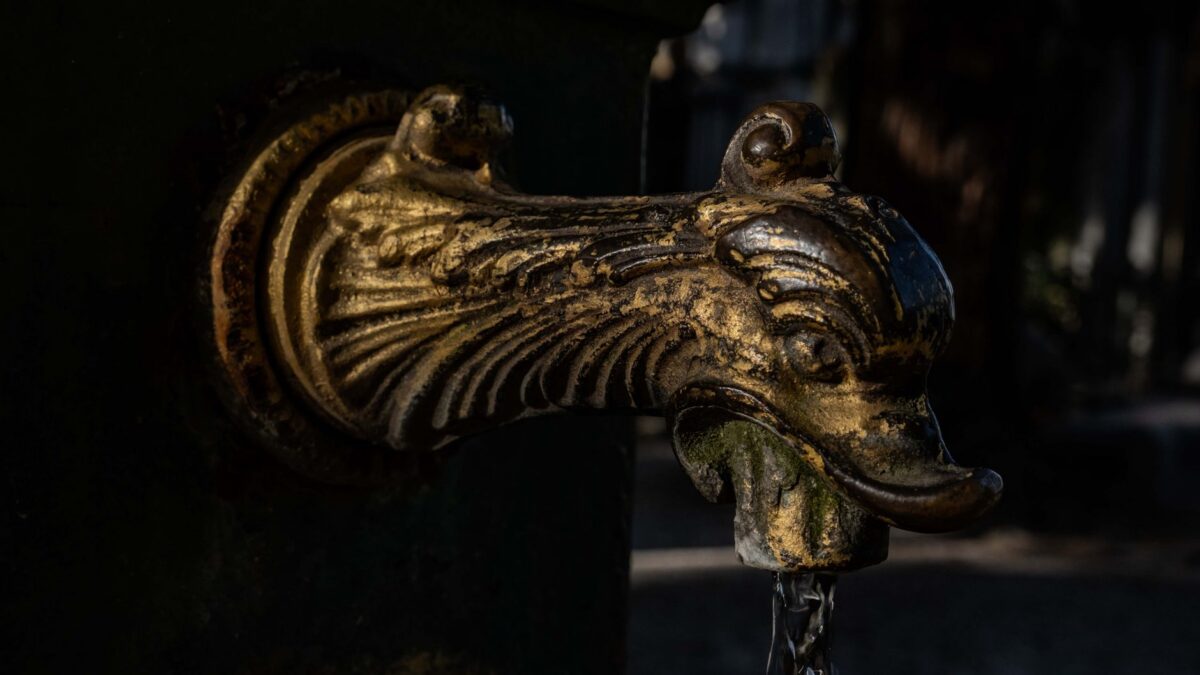
A nasone (plural nasoni, “large nose”) is a drinking fountain with a metal spout sticking out at mid-height. They are also called fontanelle. According to Wikipedia’s article on the nasone, Rome has between 2,500 and 2,800 of them, one tenth in the historical center. At their peak there were about 5,000.
The city began installing them in the 1870s. Sources give both 1872 and 1874 for the first one. Most are cast-iron columns, though some from the 1920s and 1930s are travertine and remain mostly in parks and the Foro Italico area. Other designs use wolf heads, dragons and lions. Examples include a nasone with two animal heads on Piazza della Rotonda and the Fontana delle Tre Cannelle in Via della Cordonata.
The water is the same supply that reaches homes, so it is safe to drink. It runs all the time from a hole at the bottom of the spout. Most nasoni also have a hole on top of the spout: cover the bottom hole with a finger and the water shoots upward, which makes drinking easier.
How do the water systems behind the fountains work?
The old fountains worked purely by gravity, so the source had to sit higher than the fountain. Today the Roman system combines gravity with mechanical pumps, and water is recycled. Water from different aqueducts is sometimes mixed before it reaches the fountains.
In 2015 the water company Acea installed ten casa dell’acqua kiosks, described as hi-tech nasoni. They give free tap and sparkling water, tourist information and a place to charge a phone. One stands outside Stazione Termini.
Tips for visiting
- Pick a route by area: Piazza Navona and its three fountains are in one place, and the Trevi is a separate stop.
- Look for the small nasoni on the street and refill a bottle, as the water is safe to drink.
- Block the bottom hole of a nasone spout with a finger to get a stream from the top hole.
- Check the official city pages before you go, as access rules at the Trevi can change.
Quick answers
Is nasoni water safe to drink?
Yes. According to Wikipedia, it is the same water supplied to the city’s households.
Why do the nasoni never stop running?
Wikipedia gives two reasons: constant flow keeps water in the pipes from stagnating, and the fountains act as ventilation valves for the water system. It says only 1% of the water is lost this way, against nearly 50% lost through old and leaky pipes.
Were any nasoni turned off?
In July 2017 Acea shut off some because drought had lowered Lake Bracciano, the city’s main water reserve. The move drew criticism, including concerns for Rome’s homeless people and local animals.
Checked against official sources in November 2026. Hours, prices and rules change: confirm on the official page before you go or apply.